



















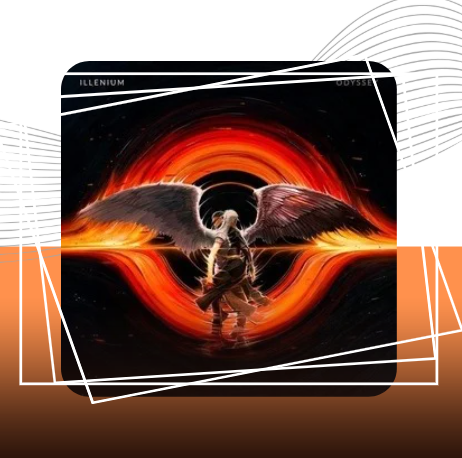
What if a music album could tell a story just like a novel could? In his latest album ODYSSEY, that’s exactly what ILLINEUM does. Throughout ODYSSEY, ILLINEUM tells a story of emotional breaking, self reflection, and growth, taking listeners on an emotional journey some of them can relate to. Each track in ODDYSSEY serves as a chapter that builds a story not about events, but about what it feels like to heal.
ODYSSEY can be split into 4 different “acts,” each representing a different stage in the narrator’s journey towards healing. The first act introduces us to the “call”, the emotional breaking that starts the healing process as the narrator fights their way through that dark place. Confronting their struggles and heading into the unknown. The second act then heightens the internal conflict the narrator is struggling with, showing us cycles of isolation and internal contradiction. From there, the third act focuses on the narrator’s collapse, where they begin to confront their role in all of this pain. Finally, the fourth act brings us to a resolution, where the narrator finally accepts all of themself and comes out on the other side.
Act I, the call & entering the unknown
The first act introduces us to the narrator’s emotional “call.” This moment of emotional breaking that begins with the track “Odyssey” that sets the tone with this sense of uncertainty, which only deepens as “Into the dark” marks the step where the narrator begins to confront their struggles. The tracks “Forever” and “With your love” explore the memories of the narrator, while “Feels like you” brings in the nostalgia and emotional distance that comes after that breaking. Act one closes with “In your arms,” which offers a short sense of comfort before the deeper internal conflict begins.
Act I highlights and ratings:
With your love (ILLENIUM, Ryan Tedder) – ⭐⭐⭐⭐
“With your love” is this moment of emotional exposure, when the narrator finally lets the walls come down. Lyrics like “Ive been messed up / Ive been lonely” sound less like storytelling and more like a confession. This track captures a vulnerability that many listeners can recognize: the point where it becomes impossible to ignore what’s weighing you down. Because of this feeling, “With your love” resonates not as a singular experience, but as a shared emotional state.
Forever (ILLENIUM, Tom Grennan, Alna) – ⭐⭐⭐⭐
“Forever” focuses on memory, more specifically, the kind that stays and lingers long after something has ended. “Tell me did we always have forever / Tell me does it hurt when you remember” captures that feeling of a quiet ache that comes with looking back on something that felt permanent. “Forever” speaks to a nearly universal experience of holding onto moments, relationships, or friendships that didn’t last the way we expected them to.
Act II, conflict & descent
The second act of ODYSSEY transforms the vulnerability we see in act one, into contradiction and instability. “Dont want your love” opens the act with rejection, immediately contradicting the earlier sense of longing and nostalgia. As we listen further, “Slave to the rithm,” traps the narrator in this self-destructive cycle. That tension reaches its climax in “War” where the narrator grapples with their own mind over letting go or going back and trying to fix the past. Eventually we shift into “I’ll come running” where that connection the narrator sought before decides to show itself despite all of the damage. Act two ends with “Take me back,” bringing all the narrators regret to the forefront.
Act II highlights and ratings:
“Take me back” – ILLENIUM, Dean Lewis – ⭐⭐⭐⭐⭐
“Take me back” leans into the narrator’s regret, focusing on the desire to return to a time before everything fell apart. Lyrics like “If I could go back I would / take me back, take me back / to the way it was / before I lost it all” express a feeling that listeners are familiar with, the urge to go back and fix or undo past mistakes, or relive a moment but with a different outcome. What makes “Take me back” stand out is that it doesn’t represent regret as something abstract, it represents it as something that’s human. Because of that, “Take me back” feels relatable, showing listeners the way we sometimes replay the past in search of a different ending.
“War” – ILLENIUM, Lo Spirit – ⭐⭐⭐
“War” represents internal conflict that follows the emotional fallout left behind by that breaking. The imagery ILLENIUM used in the lines “If pain is worth fighting for / Maybe this is war” represents healing as a battle, where the narrator grapples with holding on versus letting go. “War” captures the tension that comes with being hurt emotionally, it’s common for us to be torn between wanting to repair what was lost and the need to protect yourself. “War” shows us how difficult it can be for us to choose a path forward when both paths carry weight.
Act III, collapse & self-realization
Act three shifts the focus from external to internal, focusing on identity and self confrontation. “Love is a chemical” redefines emotion and love as something instinctive, something biological, while “Feel alive” explores emotional numbness and the narrator’s desire to reconnect. “Monster” intensifies the self reflection by forcing the narrator to confront their own flaws and role in all of the pain before “Refuge” offers a sense of emotional safety. Act three finishes off with “Not ordinary,” which shows us the narrator taking all of their struggles and hardships, and reframing them as part of this unique identity. Embracing their flaws as what makes them human.
Act III highlights and ratings:
“Monster” – ILLENIUM, EMMY – ⭐⭐⭐
“Monster” changes the focus from external to internal. Its about confronting the idea that not all pain is caused by other people and things, and that sometimes it’s us. “Monster” explores ideas of accountability and self awareness, where the “Monster” symbolizes the parts of ourselves we try to avoid. The line “I don’t wanna face the mirror” highlights the struggle many people have: the difficulty of confronting personal flaws or past mistakes. Recognizing that healing requires honest reflection even when it can be difficult.
“Not ordinary” – ILLENIUM, Kid Cudi – ⭐⭐⭐⭐
The repeated phrase “This ain’t nothing ordinary” signals yet another shift in perspective. “Not ordinary” re-shapes pain to where struggles aren’t seen as setbacks anymore; they’re seen as what makes a person unique. “Not ordinary” resonates most with listeners who have had to rebuild or redefine themselves after challenging times. It’s a move from self criticism, to self acceptance.
Act IV, transcendence and resolution
ODYSSEY’s final act brings the healing journey to a close through release and reflection. “Paris”, the only instrumental track, creates a space where the narrator reflects without words, leading into “To the moon” which signals forward movement. showing us the narrator’s first steps after leaving behind all of the emotional gravity and fallout from that initial breaking. ODYSSEY comes to an end with “Ur alive” which grounds the ending with a simple yet universal truth: The journey was never about fully healing, it was about finding the strength to begin again.
Act IV highlights and ratings:
“To the moon” – ILLENIUM, Alok – ⭐⭐⭐⭐
“To the moon” shows us when the weight of the past finally begins to lift off of the narrator. The lyrics “I know there’s something out there” suggest this renewed sense of hope. “To the moon” captures a feeling many people reach after periods of emotional struggle: the ability to let go without forgetting. Instead of erasing the past, the narrator uses it to learn and go from being weighed down to looking ahead.
“Ur alive” – ILLENIUM, WYLDE – ⭐⭐⭐⭐⭐
“Ur alive” closes ODYSSEY with a simple, yet powerful and universal message: what matters is that you came out on the other side. “Look around don’t forget you’re alive / Take a breath its alright” doesn’t offer the narrator or the listeners a perfect ending, rather it emphasizes just living in the moment and having that presence. “Ur alive” resonates because it tells us honestly that life never becomes perfect and flawless overnight, but there is beauty in continuing forward despite everything. It’s a perspective that listeners can relate to, especially after hard periods of emotional uncertainty, which makes “Ur alive” feel less like a conclusion, and more like quiet reassurance.
After everything is said and done, ODYSSEY tells this story of the emotional journey that begins with emotional breaking, and leads us down the path of rebuilding. ODYSSEY isn’t about having everything figured out, it’s about pushing through that dark place when you don’t, showing us that growth isn’t this straight line, and that it doesn’t come all at once. The reason ODYSSEY resonates so deeply is because of how familiar it feels to so many people, the uncertainty, the regret, and the moments of clarity. They aren’t these distant ideas, they’re a universal experience many listeners can recognize in their own lives. By the time “Ur alive” closes out the album the message it leaves is simple yet powerful: not that everything is perfect, but that there is still something worth holding on to; and sometimes, that’s enough.