


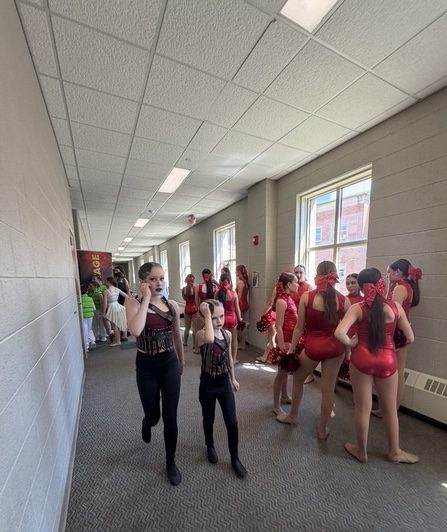











A voice booms out over the speakers: “Entry number 559, I Did It Again.” Over and over, the voice calls numbers and names of dances. The dancers shuffle on stage, perform, and bow before walking off. It’s a seamless routine; a bit of a dance itself. But backstage and in the studio, it’s chaos—the best kind.
The Day of the Dances
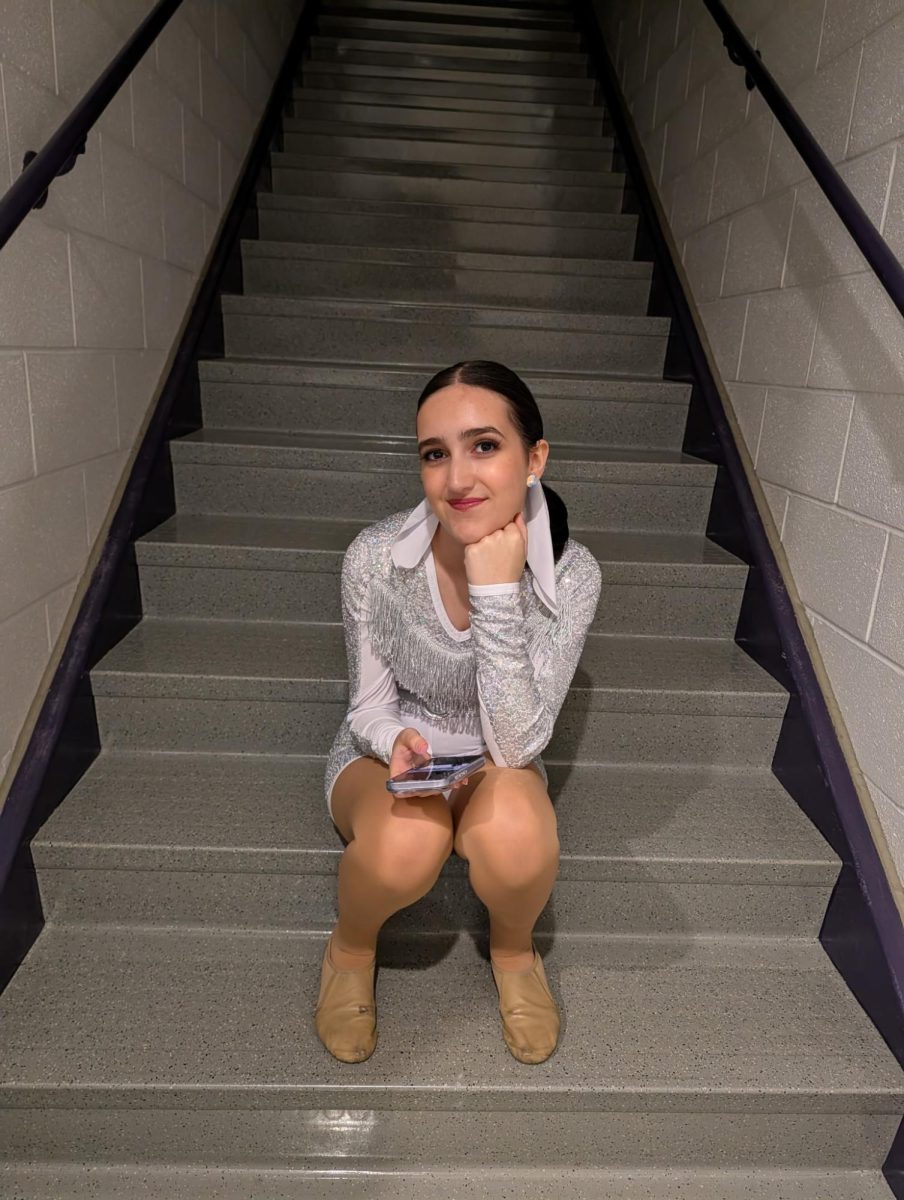
On her way to the competition, 19-year old Alivia Rosado shuffles through her playlist—a bit of Glorilla, a bit of Cardi B. It’s Spanish or hip hop, and it’s her hype music on the way to the venue. Alivia has been dancing for 16 years, 13 of which she’s been a competitive dancer. She started at age 5, competing with tap and jazz at her old studio, Dance Connections, before she relocated to Legacy School of Dance and joined their competitive Pom team (Pom being a style resembling cheerleading). Once Legacy expanded the variety of competitive styles they offered, Alivia jumped at the opportunity; she now competes in Pom, jazz, and hip hop, and has been captain of the jazz team for 5 years before becoming hip hop team captain this year. While she started competing because her mom enrolled her to get more involved in her first studio, Aliva now competes for herself.
Her passion for dance and for competition has never wavered, despite the way things have changed around her. Alivia is one of the oldest dancers at the studio, and she’s watched the rosters for competition teams change throughout the years as older girls move on and younger girls join competition.
Additionally, when she was younger, at Legacy the students always performed for other classes and gathered at the studio for competition, where they had pizza and did their hair and makeup together in stations. Now, because Legacy has grown as a competition school, Alivia enjoys a nice pasta dinner the night before a competition, listens to her dance music and counts (as dancers use numbers to remember when to do a movement with the music), has a pep talk with Mom, reads herself to sleep, wakes up early every morning, does her hair and makeup herself, and drives herself to the venue.
And while the preparation process has become more individualized, the teams this year are closer than ever. “This year I feel like by far has been the best year we’ve ever had with competition,” Alivia said. “I don’t think I’ve ever had this (much) fun at a competition since (a pom) dance (when she was younger). Being with these kids, even though they’re so much younger, they’re so good and they’re just so excited to be there. It’s such a different environment. I love it. I can’t wait for nationals. I am so excited.”
However, Alivia is about to age out of the age range that Legacy submits their dances under, meaning that she won’t be able to compete next year. “I love the thrill of being on stage, and it’s sad because it’s my last year, especially with competition because I’ve been doing it since I was little,” Alivia said, smiling sadly. “Dance is my life; if I could keep doing it till the day I die I would because I love the thrill of being on (stage). The team, the people, everything.”
While she might not be on stage, Alivia has begun teaching younger girls recital routines and has been choreographing with the studio’s teachers. From a new perspective, Alivia understands all of the hard work and chaos that goes on behind the scenes to get dancers ready for a competition. There’s stress and responsibility, which she understands since becoming captain and assuming a leadership role. When she was younger, she had to worry only about herself—now, she’s a comforting presence and parental figure to all of the younger competitive dancers around her.
At competition, she’s surrounded by a hoard of them, making sure girls’ nerves are calmed, they know their counts, and that everybody has what they need medically once they get offstage. She still makes sure to hold the students to a high standard, but one of the reasons she came to Legacy is what makes its competitive atmosphere stand out: everybody is there to have fun.
Her previous studio had a toxic competitive environment, but since she was little, Legacy has emphasized that competition is supposed to be enjoyable and makes sure to keep a strict although relaxed environment surrounding competition.
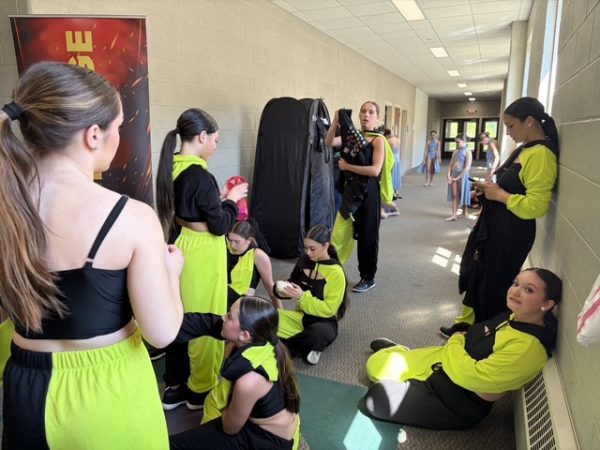
It’s this air of excitement and fun that makes competition day a special day—or weekend, in some cases. Once Alivia arrives at the venue, it’s a whole different competition when trying to find space to set up one’s home base of costumes, makeup, food, and personal belongings backstage. Dancers from other studios rush and race backstage, everything smells like deodorant and hairspray, and the music from the numbers on stage blares loudly.
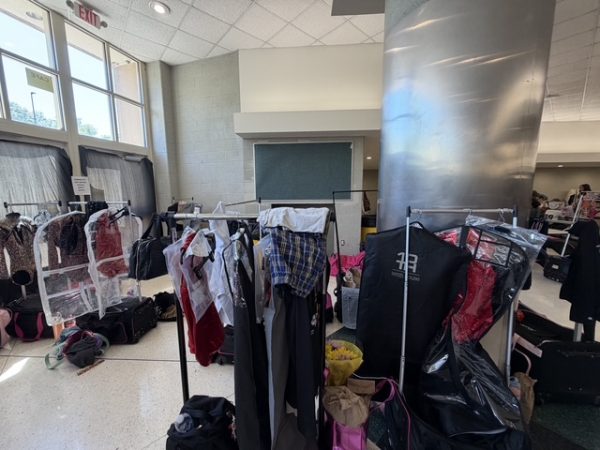
Once she squeezes herself into a spot with her studio and that first battle is won, it’s time to stretch, mingle in the audience, and regroup with her team backstage. Together, the team planks for one minute, a technique used to strengthen one’s core for turns in jazz, pom, and lyrical routines.
Then once they rise, they hold each other’s hands in prayer, and shake their hands and feet. Four shakes for each limb, the team chants the counts together, erasing nerves before they go on stage. Before they know it, they’re lined up, on stage, and the music is over. Hours of anticipation culminates in two and a half minutes and leaves you breathless.
Your adrenaline carries you throughout the day—through the next routines you perform after, through the jitters at awards, and ultimately powers you through a potential shopping spree or dinner out with the team depending on the venue. And while adrenaline is an underlying factor, you need much more than that to participate in competitive dance. It’s strength, endurance, muscle memory, and confidence. “(You need) a lot of confidence and just wanting to be there. You can’t join a competition team and not expect to be like, oh, I’m just gonna do this and not go to class, not be prepared, not be willing to put in the effort,” Alivia explained. “There’s a lot of effort that goes into comp teams, especially the girls that just joined this year. They’re like Liv, I didn’t realize how much work goes into this.”
This year, the Legacy competition teams are heading to Nationals June 24th through the 28th. Alivia is looking forward to her last time on the competitive stage, but she knows this isn’t the end of her journey. “I love dance,” she said. “I never want to stop.”
Endless Hours in the Studio
11-year old Olivia Simoes hasn’t been dancing as long as Alivia, but it doesn’t mean she’s not privy to competition herself. Since 2020, Olivia has been on the Legacy Pom team for 7 years, adding hip hop, acrobatics, and jazz for the latter three of the seven once Legacy added competition classes for her age. In the last five years, she’s been a captain for Pom for 2 years, captain for jazz one year, and captain for her acrobatic competition team this year.
Olivia started dancing competitively during COVID after her friends inspired her to try it, and that first year was unique because of the restrictions from the pandemic. The masks made it difficult to breathe, making the unbearable heat backstage that much worse. But “after I competed, I wanted to go on again and do it again,” she said.
It is that same repetition that makes a competition dance in the studio. Even with the air conditioning on, there are usually two or three fans on and when the music stops, everyone drops dead, panting and sweaty. Then you get up and do it again—sometimes in almost-darkness, so you become more attuned to where you and your fellow dancers are.
This fierce repetition is essential, because the dances are taught and therefore reinforced much quicker than certain numbers that are reserved for Legacy’s summer recital, a performance for friends and family. The dance season begins in August, tryouts for competition teams are around late September to mid-October, and the dances have to be finalized around January for competition season in the spring.
While Alivia said confidence and effort was key to competitive dance, Olivia recognizes what you need off of the competitive stage and in the studio when it comes to learning the dances. “You need to learn dances easily,” Olivia said.
“And if you don’t, you learn how to. You have to be confident and not give up on everything and keep working hard even if things get harder.” Olivia recognizes that since competing, routines for competition differ from those for recital—they’re faster paced and more difficult. Not only that, but once you arrive at the competition, there’s more chaos because it’s less structured than recitals.
“Your schedule could change and you could have quick changes,” she said before she elaborated on the professionalism and strict rules of competition. “Comp is more hard because you can’t act crazy because there’s judges and we don’t want our teams getting disqualified.”
And while Alivia attributed to Legacy’s welcoming, playful, yet determined atmosphere, there’s still a part of competitive dance that becomes stricter than most, and that’s tryouts. When Alivia was younger, students were called into the studio in groups, where they performed in front of the teachers, who were lined up behind a table and took notes on clipboards.
Now, Legacy has taken a different approach: students go in individually, and aside from performing longer choreography and the required turns, leaps, and tricks, they’re allowed to feature something that they would like to show the teachers. It’s become more personalized and individual, and more laid back because the teachers don’t sit like a judges panel anymore. However, to some, the idea of dancing alone can be daunting, especially when you’re used to dancing in a group.
But Alivia said, “I love performing by myself, which a lot of people hate, but I love doing the dances by myself. So I feel like that’s a hard thing for people because you have to go in by yourself. The teachers are just standing there.”
Olivia recalled her first tryout with the old system, saying after the audition, “We came out, we were happy. Like excited, also a little nervous.” With the new system, Olivia said, “I like how it’s just by myself (because) they have to pay attention to me and help me if I make mistakes.” She also found that there is less pressure auditioning with others because you’re more focused on yourself, not another person, especially if they’re watching you.
Once you make the team, it’s countless hours in and out of the studio. As a way to balance the stress of competing, Olivia likes to try to improve individually in everything. She stretches daily to improve her flexibility and teaches herself more acrobatic moves so that she improves overall as a dancer, all the while practicing her dances and her counts.
Aside from individual improvement, everybody leans on their teammates. “It’s really fun to have these opportunities,” Olivia said in regards to competition, “but my friends like competing and then it just brings all of us closer and we get better friendships. You also meet other people on different teams because all the teams meet up and then you can make more friends during comp.” Competing together brings you together, regardless of what team you’re on.
The night before a competition, Olivia will call her teammates and they’ll go over dances, giving tips and tricks and generally hyping each other up to calm their nerves and stay positive for the competition. “I feel like no one really thinks about how we learn the routines and how we all come together and become friends over, like, one year—and it’s not even a full year; we become friends in like, 2 weeks,” Olivia said. “We become friends really fast and don’t just dance. We have conversations and have fun days out of the year and it’s just totally different than regular dancing.” C
ompetition classes allow you to become more of a family than your normal recital classes. Pressure makes diamonds, and in this case, the diamonds are the familial bonds.
Olivia thinks these relationships are a hidden reality of competitive dance, but Alivia has experienced something else. Legacy is different from her old studio because they don’t care about your body size. Alivia has seen at other studios that skinnier girls get to dance in front and girls that aren’t as thin aren’t put in the front despite technique and skill. She explained that this contributed to body issues and eating disorders, and that some people see the body type and think it’s athleticism and don’t realize that’s not what it is.
The perfectionist part of it and the competitiveness can also lead to really bad OCD in toxic environments. “That’s why I really love Legacy,” she said. “Because you don’t get that type of mental state. You are there just for fun.” There are more competitive studios where body image is factored in, but at Legacy, that is never the case. The Legacy instructors stress the importance of performance and effort. There is not so much pressure that you can’t enjoy the dances themselves and the friends you do the routine with.
Stepping off the Stage
While Alivia is nearing the end of her competitive career, Olivia plans to keep trying out and working hard for competition teams. She plans to keep competing because “I’ve grown as a dancer competing, and it helps me learn more things,” Olivia said, “and I make new friends every year because the teams, they switch every year, and they don’t just stay with the same people.” She doesn’t see the changing teams as something daunting, but rather as an opportunity to get to know more people and grow as a dancer.
A lot of people think competitive dance is about winning gold. But throughout all of the changes in one’s competitive career, after the blood, sweat, and tears, it’s about one’s passion for dance and their love for their dance family. And at the end of the day, all of the hard work is worth it.