














There are only sixteen days until January first. And while some are counting down the days because of Christmas break, or with anticipation for the new Year, EHHS seniors are marking their calendars because January first is important for an entirely different reason: college application deadlines. From the month of November until as late as February first, the winter months are the height of the college application season. But how does the process work?
What are college applications?
There are three main platforms through which college applications are submitted: Common App, Coalition, and Questbridge. Common App and Coalition are both used to apply to multiple universities, but Common App is more widely accepted than Coalition. Meanwhile, Questbridge is a specialized college application platform, nonprofit organization, and scholarship program for high achieving, low income/first generation students; it has a ‘National Match program’, where students get early admission and a full ride scholarship if matched with a college.
The process begins with writing your college essay and making your college list. In this stage, it is important to consider factors like the programs they offer, geography, cost, size, and competitiveness, and make sure you have safety, match, and reach schools (schools you are more than likely to get into, schools that you should get into, and schools where it is less likely you’ll be accepted). Once you have an idea as to where you’d like to apply, fill out the application platform you choose to apply through. After you add the schools you wish to apply to to your platform, you’ll have to work on the additional essays they ask you to write (separate from your main ‘college’ essay, called supplementals) and request transcripts and recommendation letters.
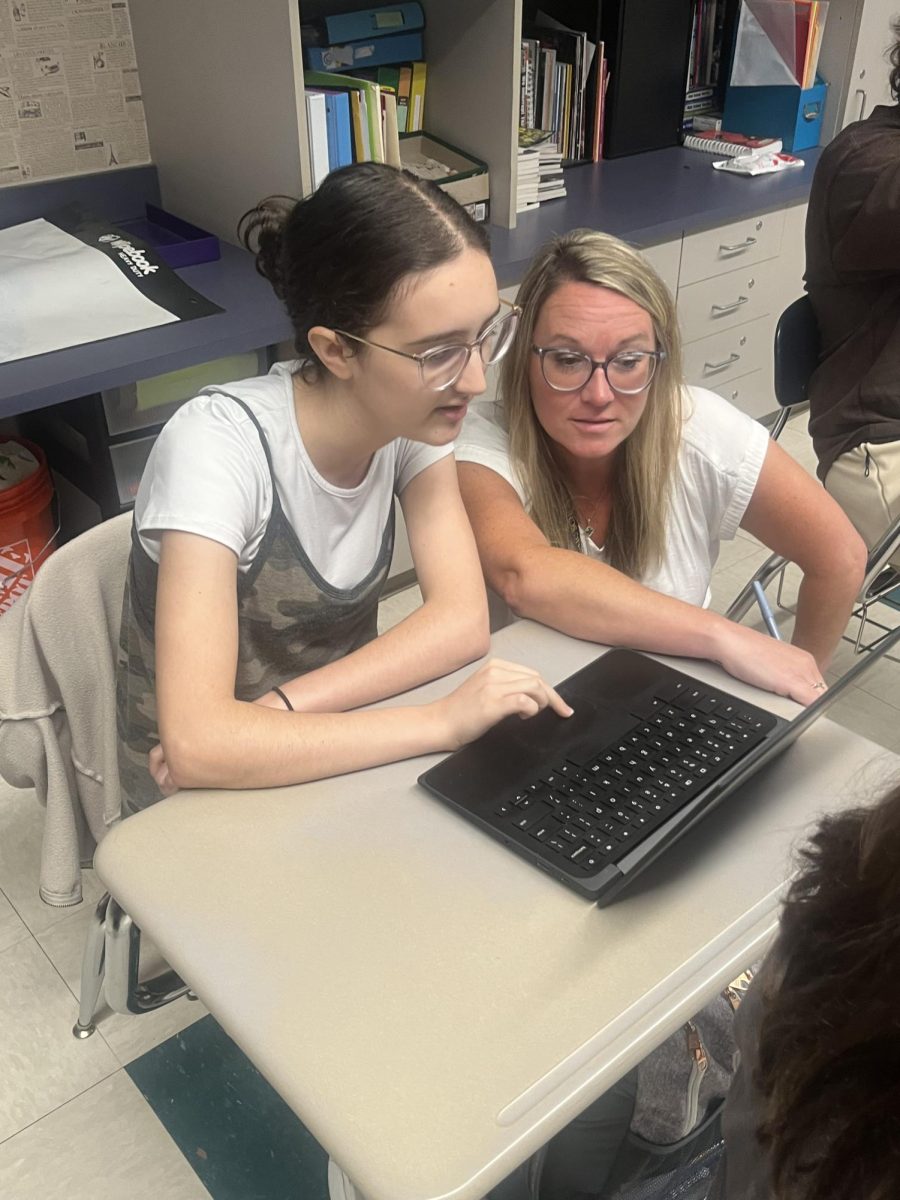
Letters of recommendation primarily come from your teachers, who also help you by reviewing your supplementals. Teachers are an important part of the college application process because they show your growth and achievements when recommending you and give colleges an in-depth look as to who you are inside the classroom and how you will contribute as a student. English teacher Mrs. Lisa Gardner said, “They’re gonna see you on your good days, they’re gonna see you on your bad days. They’re gonna see you when you struggle with something and you need to overcome that. They’re gonna know all those little details that I think other people may not know, right?…That’s what the colleges are interested in. They’re interested in the work that you’ve kind of put in to become what you are.”
Not only do teachers share a piece of your high school experiences with colleges, but they also help highlight your personality in the written components of your application. “You’re all statistics somewhere, but in our classroom, you’re all those unique individuals. We know those stories where you don’t see yourselves like that,” History teacher Adam Gardner said in regards to supplementals and the college essay. A more personal style of writing, the college essay and supplementals are not academic pieces where you use evidence to prove a point—instead, they’re solely about you, and that’s the part that can be tricky. Mr. Gardner continued, “It’s very difficult ’cause you guys don’t write like that. You don’t write about yourself, you don’t know how to explain yourself.”
When reviewing, teachers aren’t only looking for good organization, structure, content, and grammar; they’re making sure that you are the heart of the essay and you’re showing who you are, whether it be as a person, a student, or member of a community. “Anybody can write down, I’m a leader, I’m a good student, I’m a good athlete, right? But showing how you do those things is what’s most important,” Mrs. Gardner said. The experience of a teacher—of someone who has gone through the process themselves, is surrounded constantly by the application process, and is privy to its ins and outs—is an invaluable member of a college applicant’s support system.
What about all four years of high school?
While the process itself doesn’t ramp up until the end of junior year/the beginning of senior year, your entire four years of high school go into your college application. So what can you do all four years to really stand out? How do you craft a compelling college application that is unique to you?
The first thing to consider is academics, especially since the high school journey is different for each person. While it may seem like loading up on honors and AP courses in your senior year is the perfect way to impress a college, it’s important to remember that colleges look for course rigor, but what is ‘challenging’ or ‘rigorous’ is different for each person. “It’s not just saying, Well, I’m gonna take all these AP and honors classes my senior year, though I’ve never had any of them before, but I want colleges to think highly of me,” said Ms. Michelle Madonna, one of four guidance counselors here at EHHS. “What they think more highly of is that you are always challenging yourself, and sometimes you don’t get that A, but you’ve challenged yourself in a way that suits you to push yourself beyond your comfort level.” Dual enrollment courses—courses that offer college credit—are also important to consider when selecting courses, and preparing for standardized testing come your junior/senior year is crucial when it comes to the academic portion of your application. But make sure that you explore during course selection, and that you take classes that demonstrate your interests and ambitions.
Making sure you get involved is another very important part. In school, participating in clubs, sports, and programs, and looking for things outside of school to get involved in, whether it be internships, jobs, or volunteering opportunities are crucial for making you stand out on your application. Being a part of your school community and other communities not only allows you to gain experience in something that interests you, but may also introduce you to a pathway you enjoy that may lead to a career.
Senior Keara DeMatteo has done all of this. An aspiring nurse looking for a Bachelors in Science for Nursing, Keara has taken many honors and AP courses, but it was her electives that led her to nursing. After taking Careers in Health Science, Keara was inspired to go into the nursing field and continued to take health-related courses, such as Anatomy and Physiology. “I’ve definitely gotten an experience [as to] what healthcare is. And the good thing about talking to Ms. Martin is that she’ll be very honest with you about what healthcare is like,” Keara said. Now, she’s the president of Health Occupations Students of America (HOSA), a club she joined as a sophomore. Additionally, Keara has surrounded herself with experience in the field by volunteering as a patient aid at Yale New Haven hospital, where she answered call bells, served meals, prepped patient rooms, and restocked the nurses’ protective garments. Here, she learned that while nursing is difficult, it’s fulfilling nonetheless. This, in addition to her course load, has allowed her to feel like she understands and is prepared for her field. “I do think that the skills I learned there and [in] a lot of the AP classes, like time management and stuff like that, will end up helping me,” Keara said, “just because college is hard, nursing school is hard, but as long as you know how to manage your time and you know how to put a lot of effort into your work, I think you’ll be fine.”
But the college application process is different for everyone. Based on the schools you’re looking for and the programs you’re interested in, there may be different things for you to consider or things you have to do. For example, due to the competitiveness and selectivity of her major, Keara is looking for direct admissions (which in terms of a college program department, means that you are accepted into a specific major or program and you are a full member of the program upon immediately coming to university as opposed to entering undeclared or applying for a major later) into a nursing program. To earn your license for Registered Nursing, you must pass the nationwide NClex exam, which you need to pass to graduate and get your degree. This additional nationwide requirement has impacted her application process in that she is looking for programs that have a high NClex pass rate to evaluate their programs.
Meanwhile, senior Eric Colon Berrios is looking for a Bachelors in Music Education, which would make him qualified to teach K through 12. He intends to be a high school band director, and an independent music teacher. Eric has always been passionate about music; he’s taken at least one music class every year of high school, including Beginner Piano, Intro to Music Production, Symphonic Band, Beginner Percussion, and Concert Choir. He has also done competitive Marching Band and Indoor Percussion for about 3 years, where he plays the piano and guitar. These experiences helped him not only cultivate his passion for music, but it steered him towards the educational side of music. “In high school, not a whole lot of people are interested in music in general, and I just think that’s kind of a tragedy,” Eric explained. “I wanna help that out. Even if you’re not going into music as a career, you should still be interested in it and like learning how it works and all that stuff. Find appreciation for it.”

However, this field has a more complex process in that it has different focuses based on instrument and genre that vary based on the college, and requires him to submit an audition along with his Common Application. In regards of Western Connecticut State, Eric plans to apply through the instrumental music track, through the jazz piano pathway. For his audition, he has to prepare and play 3 songs on the piano and must demonstrate advanced musical qualities, like sight reading (playing a piece just based on the sheet music for the first time, which tests how well you can interpret tempo, notes, rhythm, and more).
What’s it like?
So, depending on what you want to do, the college process looks different for everyone. But what doesn’t change is that everyone generally feels the same way: a bit of fear, excitement, and nostalgia. “It’s deer in headlights,” Mr. Adam Gardner said when describing how the seniors appear during application season. “So this is extreme, worry and hesitation. There’s a sense of, oh, I’ll get it done, and I’ll be fine, but I’m not quite sure what to do.”
“I’m not gonna lie,” Eric laughed. “It’s a little overwhelming. ‘Cause I have to add a whole audition part to the Common app. And the fact that not every school has the same audition process is a little overwhelming, but I’ve had some support from my teacher, it’s manageable.” While the balancing schoolwork and college stuff is difficult, there are also parts of the application itself that can be fun; Eric says learning the pieces was an enjoyable part of the process.
When writing for the college about yourself, you come to find that the process overall requires a lot of introspection, which can be both heartwarming and bittersweet. “My essay was about a very difficult time in my life,” Keara began. “(I think) the resurgence of those feelings and… how much I struggled in that time, it definitely kind of did make me a little bit sad to have to talk about it in the essay, but overall it was just to show how I’ve persevered and grown. So knowing that I’m able to get through that, and then now that I’m able to write about it, again, I think definitely gives me a little bit of hope for my future…this college application season has been stressful, but you’ve also done a lot of personal growth.” Even though it can be overwhelming and stressful, the application process is also the culmination of all of your hard work and growth and a time of excitement and hope for the future; in a way, it’s its own celebration.
Tips and Tricks
While there are variations of dates for when applications to college must be submitted by, there’s no start date for beginning the college application process. Regardless, it’s better to start early, whether that’s asking for rec letters late junior year, brainstorming/writing your essay, or visiting college campuses in your search for where you want to attend. Eric said, “Don’t procrastinate. Do stuff on time, but have fun with it as well because it’s for you and you shouldn’t dread it. Balance it out.”
“If I’m talking to a freshman, I’m going to tell them study as much as you can, get involved as much as you can,” Keara said.
For seniors especially, it’s important to attend the workshops the guidance department hosts, make appointments with your counselors, and have your teachers help edit and review the writing portions of the application. Ms. Madonna’s advice is to be organized, and break the process up into small pieces so that it’s more manageable. Lastly, it’s okay to ask for help! “Take that first step,” she said, “which is just scan that QR code, and don’t be afraid to come down and say, I don’t know yet.” There are QR codes posted outside guidance for scheduling appointments with your counselor. Whether you’re a freshman with questions, a sophomore with ambitions, a junior making preparations, or a senior nearing the end of the application process, it’s never too late to get started!